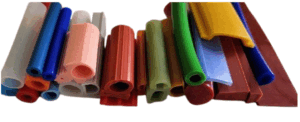
Extruded Rubber Profiles
The Complete Guide to Extruded Rubber Profiles: Selecting the Right Profile for Your Application
Extruded rubber profiles play a vital role in modern manufacturing, providing reliable sealing, protection, insulation and vibration control across a wide range of industries. From sealing doors and access panels to protecting edges and preventing the ingress of water, dust and air, the right rubber profile can make a significant difference to the performance and service life of an assembly.
At East Anglian Sealing Co Ltd, we understand that selecting the right profile is about more than simply choosing a shape. The rubber compound, hardness, profile design and operating environment all need to work together to deliver a dependable sealing solution.
What Is Rubber Extrusion?
Rubber extrusion is a continuous manufacturing process used to produce rubber profiles with a consistent cross-sectional shape.
Unlike moulded rubber components, which are formed within a mould to create an individual three-dimensional part, extrusion involves forcing uncured rubber through a precision-engineered die. The die determines the shape of the profile, allowing continuous lengths of rubber to be produced in a wide variety of configurations.
After extrusion, the rubber profile is cured through a controlled vulcanisation process. This gives the material its required physical properties, including flexibility, resilience and dimensional stability.
Common Extruded Rubber Profiles
Extruded rubber can be manufactured in an extensive range of shapes to suit different sealing and protection requirements. Common profile types include:
D-Section Profiles
D-sections feature a flat mounting surface combined with a rounded or hollow sealing section. They are commonly used where controlled compression is required, including doors, hatches, access panels and enclosures.
P-Section Profiles
P-sections are versatile sealing profiles often used around doors, cabinets, enclosures and industrial equipment. Their design provides an effective compression seal while offering straightforward installation.
U-Channels and Edge Protection
U-channels and edge-protection profiles are designed to fit over the edge of sheet metal, glass, plastic or other materials. They can protect vulnerable edges, improve appearance and help prevent contact with sharp edges.
Hollow Cord and Tubing
Hollow rubber cord and tubing can be used for a variety of sealing applications. Where required, extruded lengths can be joined or spliced to create continuous perimeter seals in bespoke sizes.
Bespoke Extruded Profiles
Where standard profiles cannot provide the required performance, bespoke extrusion can offer a solution tailored to the application. Profiles can incorporate different geometries, mounting features and material combinations to meet specific engineering requirements. Since 2002, East Anglian Sealing Co Ltd have concentrated on these bespoke designs – each supplied to specific customers requirements.
Choosing the Right Rubber Compound
The environment in which a rubber profile will operate is one of the most important considerations when selecting a material. Different rubber compounds offer different levels of resistance to temperature, weathering, oils, chemicals and other environmental conditions. These are just a few of the more common materials used.
EPDM
EPDM is widely used for external and weather-sealing applications. It provides excellent resistance to ozone, UV exposure and weathering, making it a popular choice for outdoor applications and environments exposed to the elements.
Neoprene
Neoprene offers a useful combination of mechanical strength, flexibility and resistance to environmental conditions. It is a versatile material for a broad range of industrial sealing and protection applications.
Nitrile (NBR)
Nitrile rubber is particularly suited to applications where resistance to oils, fuels and certain chemicals is important. It is widely used across industrial and automotive applications where exposure to petroleum-based fluids is a consideration.
Silicone
Silicone rubber is well suited to applications involving demanding temperature conditions, providing excellent performance across a broad temperature range. Depending on the grade selected, silicone can also be suitable for specialist applications within industries such as food processing and healthcare.
FKM
Fluroelastomers are used in some of the most extreme conditions. Typically in chemical or aggressive oil or fuel environments where other compounds rapidly degenerate and fail. By using simple extruded profiles, in this, and other materials, we can cut, mitre and join to form gaskets meaning that waste material is minimised and costs kept low.
Many other elastomers are available, also in both solid and expanded (foam/sponge) grades.
Standard or Bespoke Rubber Profile?
For many applications, a standard extruded rubber profile can provide an effective and economical sealing solution. Standard profiles are readily available in a wide variety of shapes, sizes, materials and hardnesses.
However, some applications require something more specific. Bespoke extrusion tooling allows a profile to be designed around the requirements of the finished assembly rather than adapting the application to an existing profile.
A custom profile can incorporate features such as:
● Specific mounting or locking features
● Multiple sealing lips
● Different hardnesses within the same profile
● Solid and sponge rubber combinations
● Adhesive backing for easier installation
● Complex cross-sectional geometries
● Profiles manufactured to specific dimensional requirements
Finding the Right Extruded Rubber Profile
Choosing the correct extruded rubber profile involves considering the complete operating environment, not simply the dimensions of the seal.
Important factors include:
● Profile shape and dimensions – how the seal will fit and compress within the assembly.
● Rubber compound – the material’s resistance to weather, oils, chemicals and other environmental factors.
● Operating temperature – the minimum and maximum temperatures the profile will experience.
● Hardness – the balance between sealing performance, flexibility and compression requirements.
● Compression and movement – whether the seal will remain static or experience repeated movement.
● Installation method – whether the profile is mechanically retained, bonded or fitted using another method.
● Service conditions – including exposure to water, UV radiation, chemicals, abrasion or vibration.
Getting these factors right at the design stage can help prevent premature seal failure and reduce maintenance and replacement costs.
Extruded Rubber Profiles from East Anglian Sealing Co Ltd
At East Anglian Sealing Co Ltd, we supply sealing solutions for a wide range of industrial and commercial applications. Whether you require a standard extruded rubber profile or a bespoke solution developed around your application, selecting the correct material and profile design is essential for achieving reliable long-term performance.
If you are unsure which profile, material or hardness is right for your application, our team can help you identify a suitable sealing solution based on your technical and operating requirements.